
Scenting Home and Personal Care Lines: A Festive First-Order Walkthrough
Scenting a home line and a personal care line in the same order feels like one project and behaves like two, because the two categories answer to different rules, different stability expectations and often different buyers. The sensible first order therefore splits the work into one shared scent direction and two separate specifications, and runs the approval loops in parallel rather than one after the other. Founders who treat it as a single brief usually end up with one category rushed to protect the other. The walkthrough below is the sequence that keeps both moving on one festive deadline without pretending the two are the same.
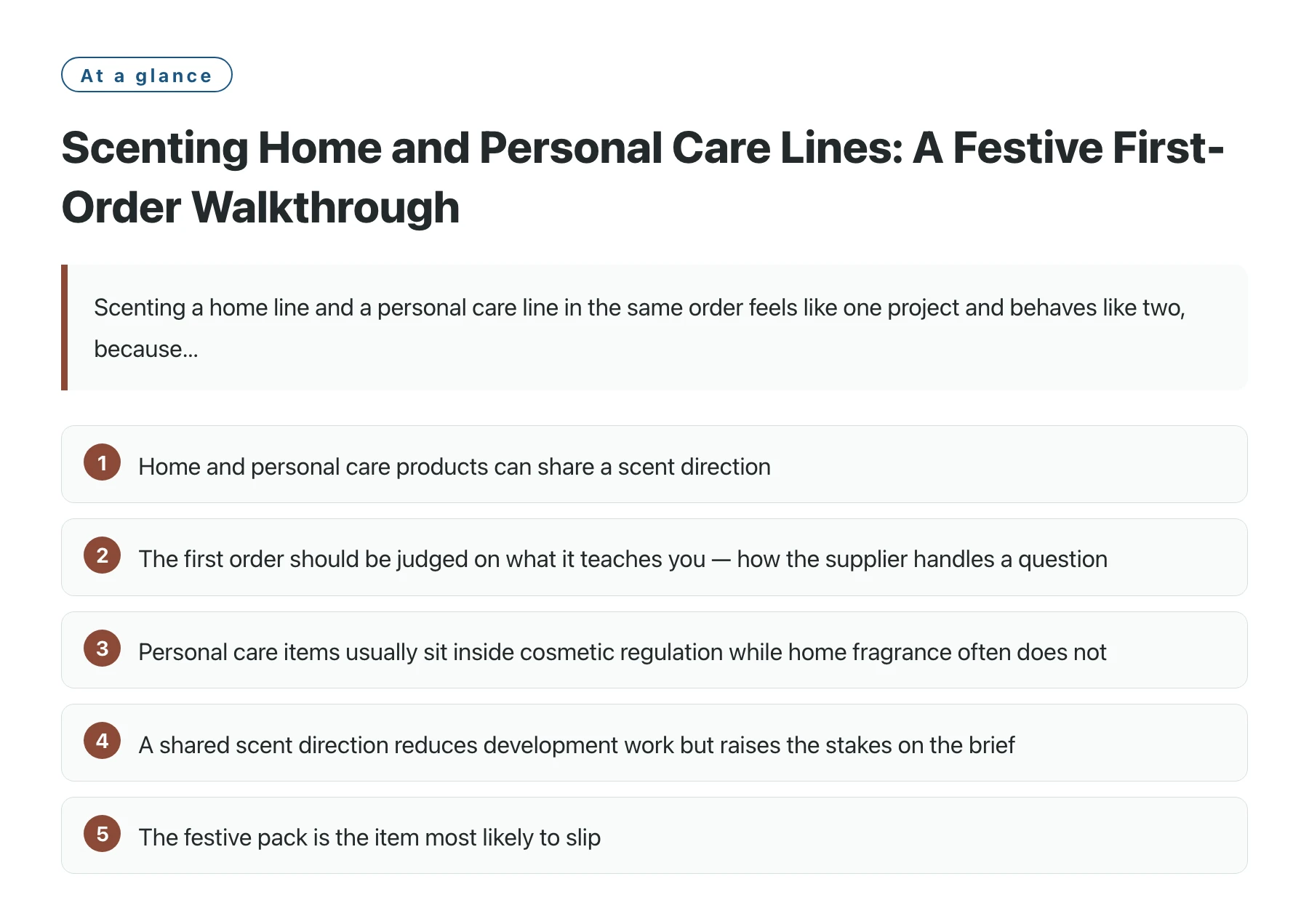
Key takeawaysHome and personal care products can share a scent direction, but they cannot share a specification, because dose, carrier and stability requirements differ by category. · The first order should be judged on what it teaches you — how the supplier handles a question, a revision and a deadline — rather than only on the unit price it achieves. · Personal care items usually sit inside cosmetic regulation while home fragrance often does not, so the two halves of the order need different documentation even when the scent is identical. · A shared scent direction reduces development work but raises the stakes on the brief, because an error now propagates into two product lines at once. · The festive pack is the item most likely to slip, since cartons and inserts are produced by a different process than the liquid and are ordered later than they should be.
This is written for the founder who has a scent direction in mind, a retailer conversation starting, a festive window on the calendar, and one order to place. It assumes no prior factory experience, because the first order is exactly the point at which assumptions are most expensive.
The sequence has five stages. They are not equally long, and the second one — samples — is the one people compress when they should compress the paperwork instead. The brand name Xuelei appears here only because the examples come from watching projects move through a working factory floor; the stages apply to any partner you choose.
What one order across two categories actually asks of you
A home line and a personal care line look similar on a shelf: both carry a scent, both need packaging and both need a story. Underneath, they diverge quickly. A reed diffuser, a candle and a room spray each release fragrance differently, at different rates and with different expectations about how long the scent should last. A body lotion, a wash and a hand cream each sit on skin, which brings in a stability question that a diffuser never has to answer.
That divergence means the first order needs one creative decision and two technical ones. The creative decision is the scent direction, and it can genuinely be shared. The technical decisions are the dosage and the formula adaptation for each format, and those cannot be shared without producing something that performs poorly in at least one of the two categories. [1]
The founder's job in this stage is not to know the answers. It is to know that there are two answers, so that a supplier who offers a single one is asked why.
One brief, two specifications
Write the scent brief once: the impression you want, three references, what you do not want, and where the product will be sold. Then write two short specification notes, one per category, covering format, size, expected use and any claim you intend to make on the label. Handing over all three documents together is what allows a supplier to plan the work as one programme instead of two unrelated jobs.
If you need a mental model for the second half of the process, the sequence from from formula to finished bottle is the part worth understanding before the first call, because it explains why a change made after approval costs more than the same change made before it.
Regulation decides which documents you need
In most markets, a product applied to skin is regulated as a cosmetic, while a product that scents a room generally is not. The practical consequence is that the personal care half of your order needs an ingredient list that matches what regulators actually recognise, and that inventory is published and searchable. [2]
Do not assume the factory will also decide your labelling obligations. Ask which party produces the safety documentation, in what language, and whether it is delivered per product or per category. Getting that answer in the first week is what keeps the festive pack from being held at the border for a reason nobody planned for.
The first order, stage by stage
Each stage below has one job and one decision. If a stage has no decision attached to it, it is not a stage; it is waiting. The sequence mirrors what a partner such as Xuelei custom perfume would typically ask you to settle at each point, which is a useful check when you are comparing two suppliers on process rather than on price.
Stage one: the brief and the scope
Send the scent brief and the two specification notes, plus the quantity you are considering and the date the goods must arrive. Ask for a scope, not a price. A scope tells you what the supplier believes the job contains, which is the more revealing document at this stage.
Stage two: samples, and the two-format comparison
Ask for the same direction applied in both categories, and test them the way your customer will: the personal care item on skin, the home item in a room of the size you expect. Approve them separately in writing, because approving one and assuming the other is a common and costly shortcut. If you are still selecting a partner rather than a formula, choosing the right factory for a perfume brand is the decision this stage should not be allowed to delay.
Stage three: the pilot quantity
A first order does not have to be the full festive volume. A pilot that covers one format properly is more informative than a large order that covers two formats badly, and it produces real filling data on your actual pack. Decide in advance what the pilot is meant to prove, or the result will be an opinion rather than evidence.
If you would rather hand the whole scope to one partner, the case for a manufacturer that builds custom scents is that formulation, filling and packing sit inside one set of hands — which matters most when the calendar is short and the two categories need to be coordinated.
Stage four: the festive pack
Once the two specs are approved, the packaging becomes the long pole. Outer cartons, inserts and any special finish are produced on a different schedule from the liquid, and they are usually ordered after the formula has been approved rather than alongside it. Place the packaging decision at the same time as the formula decision if the festive date is fixed.
Stage five: release and the record
Before the goods leave, collect the documents you will need later: the approved specification, the approved sample reference, the safety documentation and the batch record. Founders who keep only the invoice and the tracking number find themselves reconstructing all of this in the middle of a reorder.
The first order is also the moment to write down what you would do differently. That note is the most valuable asset the order produces, because the second order will be priced, planned and judged against it.
Where first orders quietly lose money
The losses are rarely dramatic. They appear as a reprint of a carton because one line of copy changed, a second sample round because two reviewers gave contradictory comments, or a rushed air shipment because the release test was booked late. Individually each is small; together they can consume the margin on a whole festive run.
One reliable habit is to route every comment through a single person before it reaches the supplier. Consolidated feedback is not bureaucracy; it is the difference between one revision and three. The second habit is to treat the packaging artwork as frozen at the same moment as the formula, and to accept that a later change is a cost rather than a conversation.
A first order is a test of the relationship, not of the product. Watch how quickly a supplier answers an awkward question, whether they volunteer a limitation before you find it, and whether the person who answers the technical questions is the same person who will answer them in six months. Product quality can be corrected; a working relationship with a partner who tells you bad news early is what makes the second order cheaper.
Sources
- Cosmetics Europe —— The European trade association for the cosmetics and personal care industry, publishing guidance, positions and market information.
- EU CosIng — Cosmetic Ingredient Database (European Commission) —— The European Commission's CosIng database of cosmetic ingredients, listing ingredient functions, restrictions and labelling requirements under EU cosmetics law.
Frequently asked questions
Can I use the same fragrance for a candle and a body lotion?
The same scent direction, usually yes; the same fragrance compound at the same dose, usually no. A candle needs a compound that performs under heat, while a lotion needs one compatible with the carrier and stable on skin. Expect the supplier to propose an adapted version for each format and to test them separately.
What quantity should a first fragrance order be?
Enough to fill your realistic first sales channel, not enough to fill a warehouse. Many buyers start with one format at a modest quantity to generate real filling and packing data, then scale the format that works. If a supplier insists on a large first order without explaining what the minimum is made of, ask what drives it.
Does home fragrance need the same safety documentation as personal care?
Not the same documentation, because the regulatory category is usually different. Personal care products generally need a cosmetic safety assessment and a compliant ingredient list, while home fragrance more often falls under general product safety and labelling rules. Both need clear labelling and both need a named responsible party.
How long does a first order take when a festive date is fixed?
Long enough that the sample loop, not the production run, decides whether you make it. The reliable approach is to work backwards from the warehouse date, place the packaging decision alongside the formula decision, and keep one reviewer consolidating comments so revisions do not multiply.
Should I ask for a pilot before committing to the full festive volume?
If the pack configuration is new to you or to the supplier, yes. A pilot on one format exposes filling behaviour, packing labour and document handling at low risk. The key is to define in advance what the pilot must demonstrate, otherwise it becomes a small order that answered no particular question.